Here’s my latest CyberScoop interview.
Category: Cyber
My CyberTalks 2018 interview
My interview from CyberTalks:
It was a fun event; if you’re in the DC area, you should check it out next year!
Defense in Depth is cool, and you should attend on October 3rd
For five years now, Red Hat and Intel have hosted a small, but very cool security conference called “Defense in Depth (DiD)” in Tyson’s Corner, VA. Its popularity has been increasing, and this year is a sort of watershed event in the show’s history. DiD has, in the past, been very focused on the security of Red Hat’s products; this year we’re casting a wider net around the security of many open source communities.
We even have an infosec A-lister keynoting — none other than David Kennedy of DerbyCon. In case you haven’t been watching CNN, Fox News, or other high-profile media outlets’ reporting on infosec, Dave’s kind of a big deal. His security roots run deep, and I’m super pumped to hear his keynote, “The Changing Tactics of Hackers,” which will talk about how only the first T in TTP tends to change, which can be handy for developing a counter-strategy.
The whole agenda looks cool, but here are some of the talks for which I am particularly stoked:
- Joseph Conway of Crunchy Data: The “Securing PostgreSQL” breakout will look at the newly released PostgreSQL STIG, and promises to be a highly technical look at open source RDBMS security.
- Jamie Jones of GitHub: The “GitHub + Open Shift = Transparent secure pipeline to production” breakout, which will look at using GitHub Enterprise with Red Hat’s container platform, called OpenShift, to provide a repeatable deployment pipeline. Jamie promises to dig into the APIs supporting this, which sounds really cool.
- Dan Walsh of Red Hat: Speaking of containers, security rock star Dan Walsh’s breakout, the “Evolution of Containers,” will examine the exciting and fast-paced evolution of the technology, and where the community wants it to end up.
- Nathaniel McCullum of Red Hat: “Securing Automated Decryption” sounds awesome. As a long-time cypherpunk, I’ve been really excited about Clevis and Tang, which is RHEL’s network bound disk encryption technology. Encrypt all the things!
There are still conference passes available, so if you get geeked on open source security, register here.
The PTES pentesting standard is awesome and you should read it
If you’re into pentesting or red teaming, sooner or later you’ll encounter some standardized methodologies.
The National Institute of Standards and Technologies (NIST) has one called the “Technical Guide to Information Security Testing and Assessment,” or SP800-115. I’m a big fan of NIST, and this is a good place to start, especially if you care about FISMA risk management frameworks. But it’s pretty high-level, and will probably leave you wanting more.
With a little more Googling, you’ll then find pentest-standard.org. The page has a dated MediaWiki interface. It hasn’t been updated in almost a year. But those things don’t matter, this site is made of open source awesomeness.
The meat of the site lives in the PTES Technical Guidelines. It’s fairly extensive, and if you’re already somewhat familiar with information security, it can go a long way to teaching you about penetration testing.
To give you an idea of the scope of this methodology, take a look at the FreeMind map that they posted, converted here to PNG for your viewing ease.
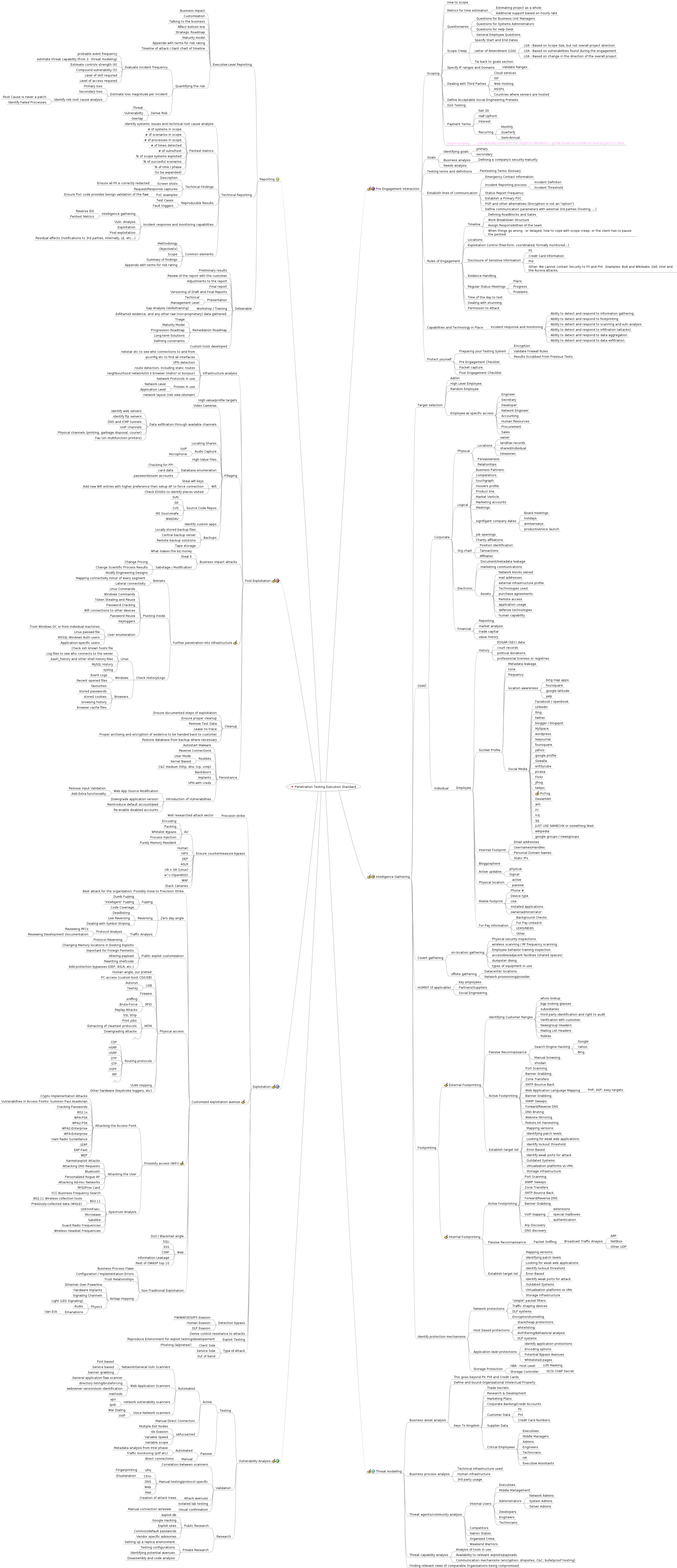
Go ahead and click on it, you’ll need to load the whole thing then zoom. It’s enormous.
Every one of these entries in the mindmap are backed up by some direction in the Technical Guidelines. Granted, PTES doesn’t hold your hand in all places, but for the devoted student of pentesting, this is invaluable stuff.
Now, to be fair, PTES is not the only game in town. There are other methodologies worth mentioning; I’ll write more about the later, but here’s an overview.
OWASP is another open source pentesting framework, but it’s focused at the web application layer. 18F, the folks behind cloud.gov and other cool stuff, requires the use of an OWASP automated scanner called ZAP as part of the ATO process.
ISSAF is another cool methodology, but it’s even harder to navigate than PTES. You can download the rar archive, or navigate the individual .doc files. At some point I hope to map PTES and ISSAF steps to one another to identify gaps in the former and contribute back to the project.
As much as I like it, PTES could really use a little TLC. There are incomplete sections. And a more modern interface would help, possibly even a migration to a GitHub Pages model, which would make community contribution easier. A D3 directed graph (example) would make for a nice, interactive mindmap.
But despite its shortcomings, I’d say it’s still the best open source pentesting methodology out there. Go check it out.
 Jason Callaway